
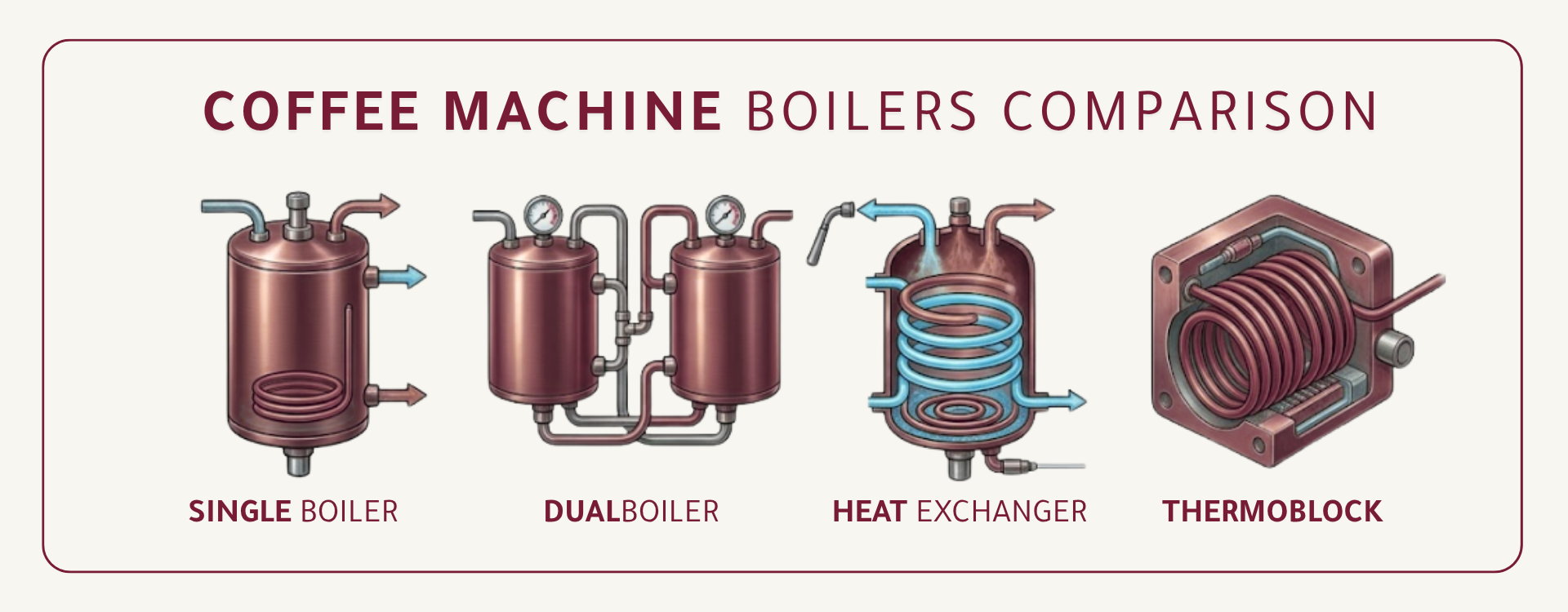
Choosing the right espresso machine does not depend solely on the brand or exterior design; the most crucial factor impacting the quality of coffee in your cup is the internal Heating System & Boilers.
The heating system is directly responsible for:
Extraction temperature stability to achieve a balanced taste without bitterness.
Steaming power for creating silky microfoam for lattes and cappuccinos.
Coffee brewing speed and how quickly the machine is ready for consecutive shots.
At Qavashop, we offer machines utilizing various heating technologies, starting from Thermoblock and Single Boiler systems, through Heat Exchanger (HX), and up to Dual Boiler setups. Each system delivers a completely different user experience and performance level.
Why is the Heating System the Core Difference in Espresso Machines?
The simple technical reason is that an espresso machine must simultaneously fulfill two vastly different thermal requirements:
Extraction Water: Requires a highly precise temperature ranging between 88°C and 96°C to preserve the flavor profile of the coffee beans without scorching them.
Steam: Requires high temperatures reaching 120°C and above to pressurize and froth milk into a creamy microfoam.
How efficiently and accurately a machine delivers these two requirements is the fundamental factor determining its price, speed, and overall user experience.
Types of Heating Systems & Boilers in Espresso Machines
1. Traditional Thermoblock System (Thermoblock / Thermojet)
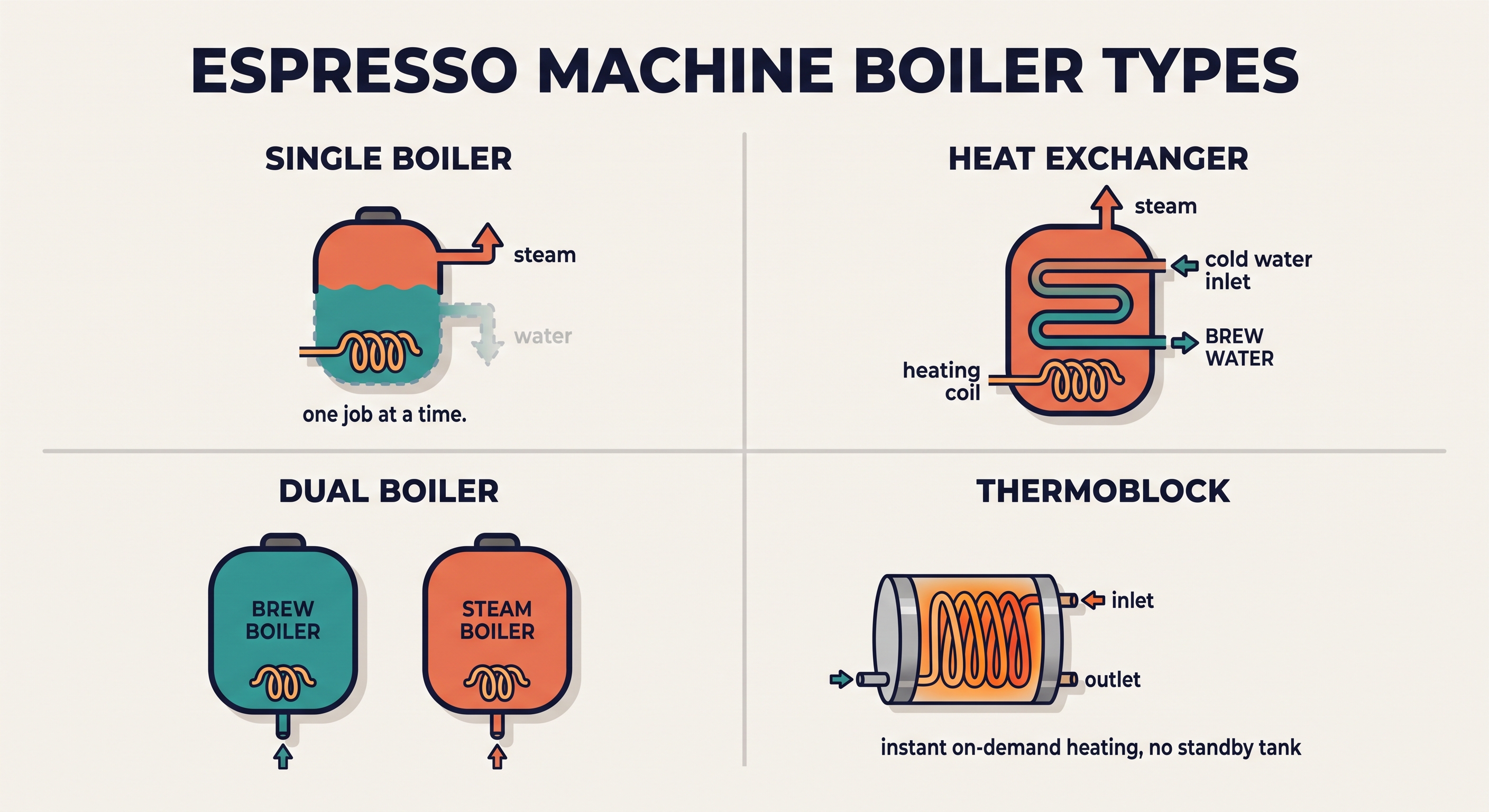
An instant heating system that does not rely on a water boiler for storage; instead, water passes through a heated coiled metal block, warming it instantly as it pumps.
How it works: Water flows from the reservoir and heats instantly as it travels to the portafilter or steam wand, often supported by digital PID temperature control in many models.
Pros: Ultra-fast startup time (as fast as 3 seconds in some models), compact size, and lower energy consumption.
Cons: Steaming power is weaker compared to traditional boilers, and thermal stability drops when brewing multiple consecutive cups.
Examples available at Qavashop:
2. Single Boiler System
The original classic system in home espresso machines, featuring a single actual water boiler made of brass or stainless steel to handle all operations.
How it works: The boiler heats extraction water first to the ideal coffee temperature (~93°C). When steaming milk, the user engages the steam button, prompting the same boiler to raise its temperature above 120°C to generate steam.
Pros: Excellent thermal stability during espresso extraction due to a pre-heated water mass, simple maintenance and operation, and an affordable price point.
Cons: Cannot extract coffee and steam milk simultaneously; requires waiting between brewing and steaming to adjust boiler temperature.
Classic Example:
Rancilio Silvia
3. Hybrid & Triple Heating Systems
Heating technologies have evolved to combine the advantages of traditional boilers with the speed of thermoblocks, offering simultaneous professional performance.
How it works: Combines a genuine water boiler with independent thermoblock units to distribute tasks efficiently between extraction and steaming.
Pros: Enables simultaneous espresso extraction and milk steaming with excellent thermal stability, powerful steam output, and faster startup times.
Examples available at Qavashop:
4. Heat Exchanger (HX)
The Heat Exchanger (HX) system is one of the most popular and widely used systems in semi-professional home machines.
How it works: Features a single large main boiler dedicated to steam. A small water pipe (heat exchanger) passes through it, instantly heating fresh extraction water to the ideal brewing temperature without boiling it.
Pros: Allows simultaneous espresso extraction and milk steaming with powerful steam pressure and long operational durability.
Technical Note: Extraction water temperature can rise if the machine sits idle for an extended period. This requires performing a quick "Cooling Flush" (purging water for a few seconds) to discharge excess heat before brewing.
Examples available at Qavashop:
Rocket Appartamento Rocket Appartamento TCA Rocket Giotto Fast Type R Rocket Giotto Fast Type V ECM Mechanika Slim Oscar 2 Oscar Mood Lelit Mara X
→ Browse all Heat Exchanger (HX) Espresso Machines
5. Dual Boiler
The pinnacle professional system in both home and commercial espresso machines.
How it works: Features two completely independent boilers: one dedicated to coffee extraction and another dedicated to steam. Each boiler is managed by an independent digital temperature controller (PID Controller).
Pros: Highest levels of temperature stability and accuracy, powerful simultaneous brewing and steaming with zero waiting time, suitable for heavy usage.
Cons: Higher price point, larger size and weight, and longer initial warm-up times.
Examples available at Qavashop:
Rocket R58 Tune Breville Dual Boiler ECM Synchronika Rocket R9 One Rocket Bicocca Lelit Bianca V3 Lita by Wendougee
→ Browse all Dual Boiler Espresso Machines
6. Manual & Portable Espresso Makers
Unlike home electric machines, these do not feature bulky boilers:
How it works: Relies either on built-in rechargeable batteries to heat and pump water automatically, like the Outin Nano, or on direct thermal heating driven by mechanical pressure, like 9Barista.
Best for: Ideal for travel, camping trips, and personal brewing on the go.
Watch: Your Ultimate Guide to Choosing the Right Espresso Machine:
Quick Comparison of Heating Systems & Boilers
Which Heating System Fits Your Daily Needs?
If you prioritize morning speed and a compact footprint:
Choose a Thermoblock system like the Sage Bambino Plus, Sage Barista Express, or Gemilai Owl.If you want a thermally stable classic entry point and favor espresso over milk drinks:
Choose a Single Boiler system like the Rancilio Silvia.If you want an advanced hybrid performance combining a boiler and thermoblock for simultaneous brewing and steaming:
Choose a Hybrid System like the WPM Primus.If you love milk drinks and demand powerful steam with professional build quality:
Choose a Heat Exchanger (HX) system like the Rocket Appartamento TCA, Oscar 2, or Rocket Giotto Fast.If you want maximum precision, full control, and zero compromises:
Choose a Dual Boiler system like the Rocket R58 Tune, ECM Synchronika, Breville Dual Boiler, or Rocket Bicocca.
Frequently Asked Questions (FAQ)
Is a Dual Boiler system always the best choice?
Not necessarily; it depends on your budget and usage habits. If your daily consumption is limited to one or two cups, an HX, Single Boiler, or Thermoblock system can offer an exceptional experience at a lower cost with faster startup times.
Does a Heat Exchanger (HX) system require previous barista experience?
It only requires understanding the basic cooling flush technique to purge excess heat before extraction. Newer models like the Rocket Appartamento TCA incorporate smarter thermal control for easier management.
Is a Thermoblock system a bad option?
On the contrary, it is an excellent and fast system ideal for anyone wanting to brew coffee in seconds with a compact countertop footprint. However, it offers less thermal stability compared to traditional boilers when pulling back-to-back shots.
How long does an espresso machine take to heat up before brewing?
Thermoblock: Approx. 3 to 30 seconds.
Hybrid Systems: Approx. 2 to 5 minutes.
Single Boiler: Approx. 10 to 15 minutes.
HX & Dual Boiler: Approx. 15 to 25 minutes for all metal components and the portafilter to reach optimal thermal equilibrium.
Final Takeaway: How to Choose Your Machine Today?
Understanding heating systems and boilers is your first step toward investing in the right machine from day one without regrets. Whether you choose the speed of a Thermoblock, the simplicity of a Single Boiler, the innovation of a Hybrid System, the steaming capability of an HX, or the ultimate precision of a Dual Boiler, you will find the perfect fit for your home coffee station.
Explore all Espresso Machines available at Qavashop and order yours today!