
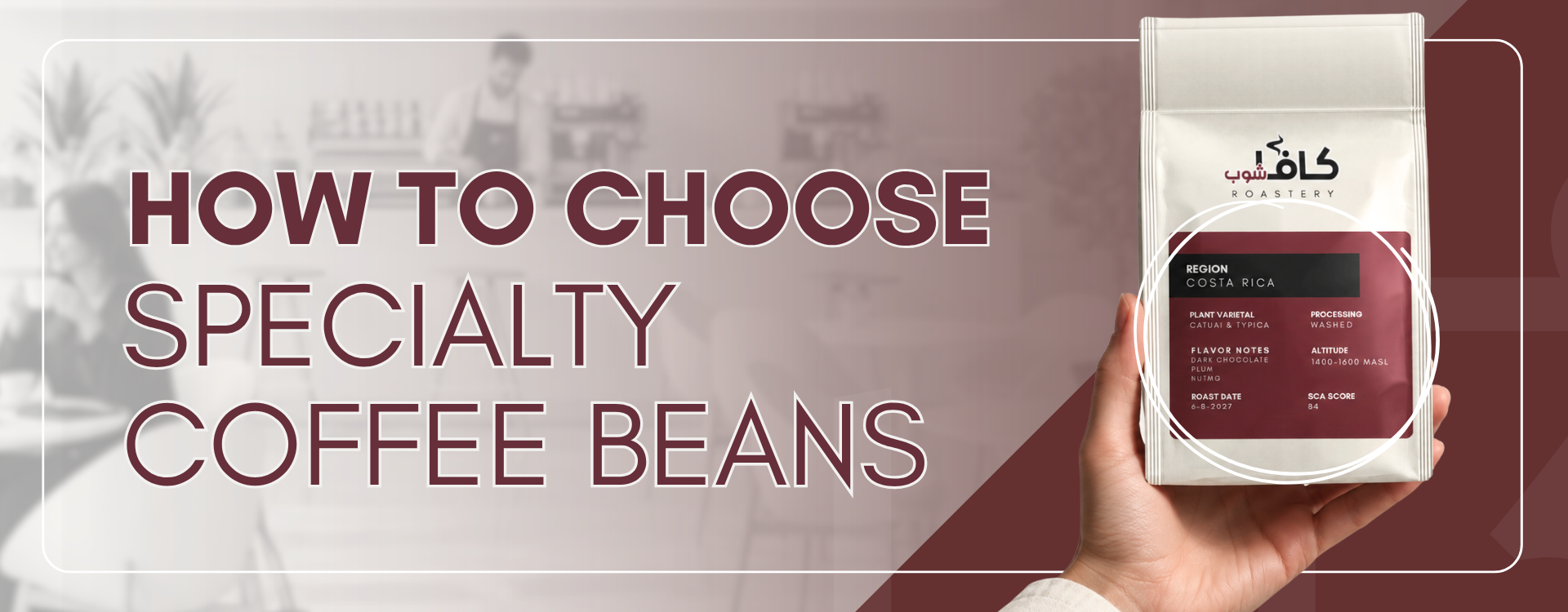
Are you standing confused in front of coffee shelves, attracted by elegant bags but unable to understand the complex English words and names written on them? You are not alone. Many of us choose coffee beans based on the beauty of the packaging, only to be disappointed by the taste later.
The real secret to choosing a coffee crop that hits the right mood lies in reading the "identity" of the crop written on the label. In this quick guide, we will simplify these "hieroglyphics" for you based on the approved rules of the specialty coffee world, so you can read the bag like a pro.
Quick Guide: How to Read a Specialty Coffee Bag
Now that you understand the big picture, let’s dive into the details step by step
1. Start with "Taste": What do you like to drink?
Before reading the technical details, ask yourself: Do you prefer coffee with a classic taste (chocolate and nuts) or coffee with a fruity and floral taste? Your answer will determine where to look in the following sections.
2. The 6 Most Important Details on the Bag and Their Impact on Taste
First: Origin and Country
The country is not just a place of cultivation; it is the "geographical footprint" of the taste due to differences in soil and climate.
- Example: If you like complex fruity coffee, you will likely prefer Ethiopia or Kenya.
- Example: If you like classic and balanced flavors (chocolate, caramel), head towards Brazil or Colombia.
Second: Processing Method
Processing is how the coffee bean is extracted from inside the cherry, and it is the factor that most affects the coffee's "body" and sweetness.
- Washed: The beans are washed and dried without the skin. Taste: A clear, "clean" cup that clearly highlights the original origin flavor.
- Natural: The entire coffee cherry is dried under the sun. Taste: A fruity, very sweet cup with a heavy body (the sugars from the fruit ferment inside the bean).
- Honey: A middle ground; the skin is removed, but the mucilage (sticky substance) remains on the bean during drying. Taste: A sweet, smooth, and balanced cup.
- Anaerobic: Fermentation in sealed, oxygen-deprived barrels. Taste: Exceptional, strong, and unconventional (funky) flavors.
Important Note: All processing methods involve "Fermentation" in one way or another, but they differ in the method, duration, and location of fermentation. This is one of the most important reasons for the difference in flavors between one coffee crop and another.
Note: You might see the word Infusion or "Infused" on some bags. This is not considered a traditional processing method; rather, it means adding external flavors during fermentation to alter the coffee's taste.
Third: Variety or Cultivar
It is the botanical family of the coffee tree, and it determines the flavor genetics exactly as the taste of a green apple differs from a red one.
- Examples: Bourbon (sweet and balanced), Gesha (the queen of varieties, floral tea-like taste), SL28/SL34 (Kenya, blackberry taste and pleasant acidity), Catimor (earthy taste).
Fourth: Score
It is a number out of 100 that determines the quality of the coffee based on the evaluation of certified experts (Q Graders), and is used to classify coffee as specialty or not.
How to read the score?
- 80 – 84: Good specialty coffee (the entry point into the specialty world).
- 85 – 87: High-quality and clearer flavors.
- 88+: Very exceptional and often rare coffee.
Does a higher number mean it's better for you?
Not always. The score reflects quality and complexity, but your choice depends on your personal taste. You might prefer an 84-score coffee with chocolate notes over an 88-score coffee with sharp fruity notes.
Fifth: Altitude (MASL)
A simple rule: the higher the altitude, the slower the coffee beans mature, which gives them more complexity, sugars, and higher acidity.
- Under 1500m: Classic flavors (chocolate, nuts) and a heavier body.
- Above 1500m (up to 2200m): Complex fruity and floral flavors with vibrant acidity.
Sixth: Roast Level
The roast level of the beans affects the final flavors.
- Light to Medium Roast: Preserves the floral and fruity origin flavors and their light sweetness (best for filter/black coffee).
- Medium Roast: Highlights caramel, cocoa, and nut flavors.
- Medium-Dark to Dark Roast: Heavy body, and the flavors of bitterness, smoke, and roasting overpower the taste of the coffee bean itself (common in commercial coffee and classic espresso).
Seventh: Roast Date - The True Indicator of Freshness!
For specialty coffee, it is not enough to write "best before"; the actual roast date must be written.
The Best: Coffee is at its flavor peak starting from the fifth day up to 4 weeks after roasting. After that, it gradually loses its beautiful aromatic characteristics.
Quick visual summary of all specialty coffee bag elements
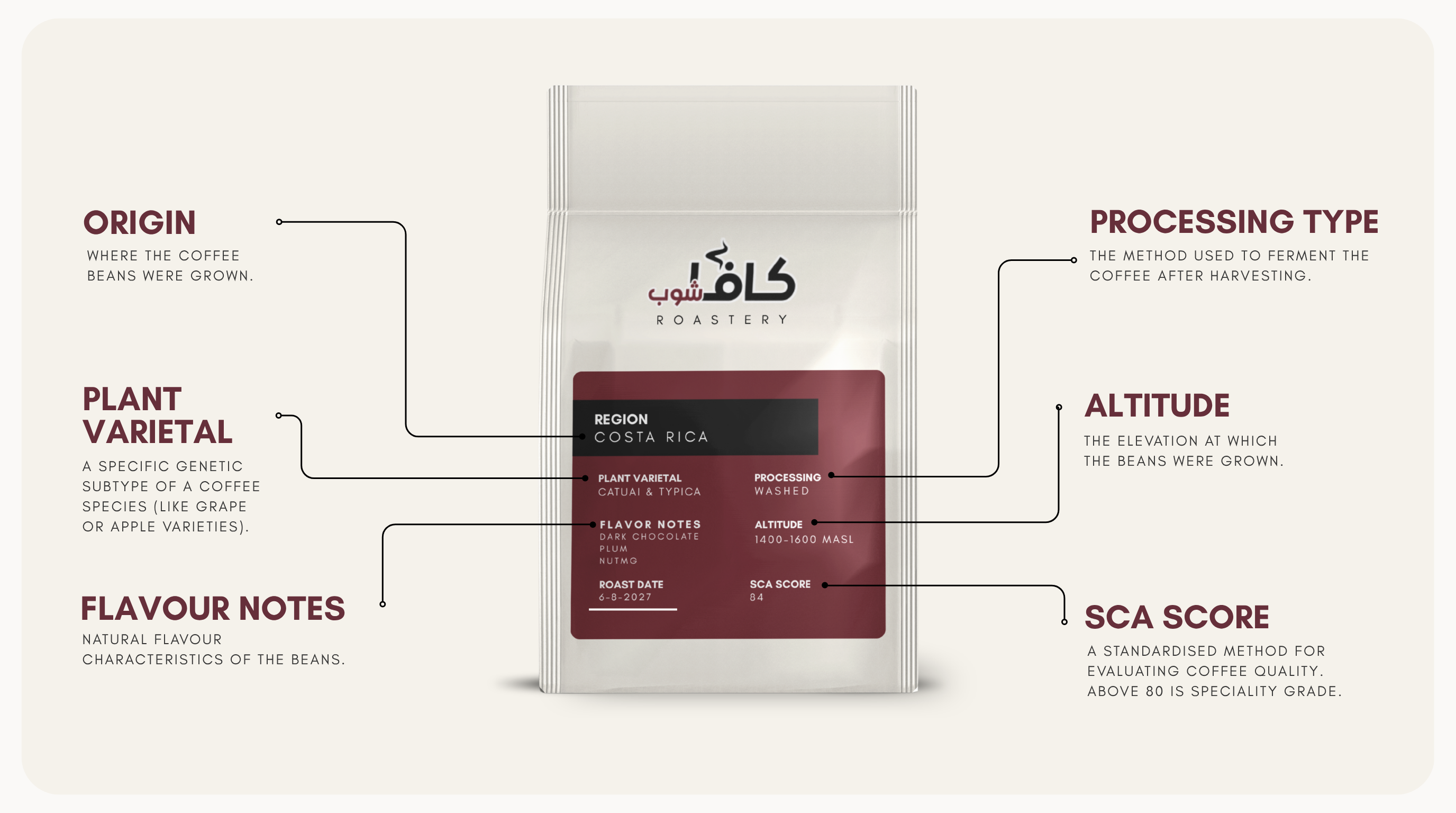
This visual guide helps you easily understand everything written on a specialty coffee bag.
Summary Table: Your Quick Guide When Buying
| Element | Meaning | Impact |
|---|---|---|
| Origin | Country, region, or coffee farm. | Determines the geographical profile (soil & climate). |
| Variety | Species/type of coffee tree. | Flavor identity (Gesha: floral, Bourbon: sweet). |
| Altitude | Elevation above sea level (MASL). | Lower = classic. Higher = fruity acidity & complexity. |
| Processing | Extraction & drying method. | Washed: clean / Natural: fruity / Honey: balanced. |
| Roast | Roast level of beans. | Light: fruity & floral / Medium: chocolate & nuts. |
| Roast Date | The day coffee was roasted. | Freshness indicator (best 5 days to 4 weeks). |
| Notes | Flavors described by tasters. | Natural flavor hints to guide your palate. |
Are you ready to choose your next coffee?
Frequently Asked Questions (FAQ)
1. What is the difference between specialty and commercial coffee?
Specialty coffee is scored 80 points or above by experts, and its path is traced from the farm to the cup to ensure it is free of defects. Meanwhile, commercial coffee is grown in massive quantities, contains many defects, and is roasted very dark to hide its poor taste.
2. How do I identify a fruity coffee just by reading the bag?
Look for bags that say: "Natural" processing, high altitude (above 1500m), African origin (like Ethiopia), and a light roast level.
3. Is Anaerobic the same as Infusion?
No, they are completely different; Anaerobic fermentation is a natural, oxygen-free process that highlights the coffee's flavors in a complex way. Infusion, on the other hand, is the addition of external materials (like fruits or cinnamon) to the barrels to change the coffee's taste and add flavors that are not originally from the bean.
4. Does coffee spoil or go bad after 5 weeks from roasting?
It does not become toxic or unsafe to use, but it loses its aromatic characteristics and oxidizes, making its taste flat or woody, and the beautiful notes that distinguish it as specialty coffee disappear.
5. Does altitude reduce the caffeine content?
This is a common belief but scientifically inaccurate. The primary factor determining caffeine content is the genetic species of the tree, not the altitude. Specialty coffee uses the Arabica species, which is grown at high altitudes and naturally contains less caffeine (around 1.5%). Commercial coffee often uses the Robusta species, which is grown at low altitudes and contains almost double the amount of caffeine.